Saturday, February 23, 2019

SRC Energy Inc. (SRCI) Q4 2018 Earnings Conference Call Transcript

Logo of jester cap with thought bubble.

Image source: The Motley Fool.

SRC Energy Inc.  ( ?????? : SRCI)Q4 2018 Earnings Conference CallFeb. 21, 2019, 11:00 a.m. ET

Contents: Prepared Remarks Questions and Answers Call Participants Prepared Remarks:

Operator

Greetings, and welcome to SRC Energy Incorporated Fourth Quarter and Full Year 2018 Conference Call. At this time, all participants are in a listen-only mode. A question-and-answer session will follow the formal presentation. (Operator Instructions) Please note, this conference is being recorded.

I will now turn the conference over to your host, John Richardson, Investor Relations Manager. Thank you. You may begin.

John Richardson -- Investor Relations Manager

Good morning, everyone. This is John Richardson, SRC's Investor Relations Manager. Thanks for joining us to discuss SRC's fourth quarter results for the period ended December 31st, 2018. With me today is SRC's CEO, Lynn Peterson; also available to answer questions during the Q&A session will be our CFO, Jimmy Henderson; Chief Operations Officer, Mike Eberhard; and Chief Development Officer, Nick Spence.

Please be advised that our remarks today, including answers to your questions, include forward-looking statements within the meaning of the Private Securities Litigation Reform Act. These forward-looking statements are subject to risks and uncertainties that could cause actual results to be materially different from those currently anticipated. Those include risks relating to commodity prices, competition, technology, environmental and regulatory compliance, midstream availability and others described in our filings with the Securities and Exchange Commission, which are incorporated by reference. We disclaim any obligation to update these forward-looking statements. In addition, we may provide certain non-GAAP financial information in this call. The relevant definitions and GAAP reconciliations may be found in our earnings release and 10-K, which can be found on our website at srcenergy.com in the Investor Relations section.

Following the prepared remarks, time permitting, we'll open the call to your questions. I would like to remind everyone that a replay of this audio webcast will be available via the company's Investor Relations page at www.srcenergy.com.

I'd now like to turn the call over to the CEO of SRC Energy, Mr. Lynn Peterson.

Lynn A. Peterson -- Chairman of the Board, President and Chief Executive Officer

Thanks, John. Good morning. We appreciate you joining us for our call today. We filed our Form 10-K last evening and you can refer to it for a detailed information. Despite numerous distractions on the political front, as well as gas processing challenges on the operational side, our team delivered very impressive results throughout 2018. First, I would like to update everyone on our view of possible changes in Colorado's regulatory framework, which is the number one question we hear from the investment community.

Over the past few months, SRC personnel, industry representatives and related trade organizations have been actively engaged with legislators and the executive branch. While it is too early to predict the outcome or the timing of any legislation, everyone has been engaged and the progress is being made on designing regulation that should strengthen relationships with the local communities. We look forward to the clarity that these efforts will provide for our investors, our industries and the communities we impact.

We continue to believe that the core of the DJ Basin, including SRC's acreage generated some of the best economics in the country. While the state continues to experience political uncertainties, it has not materially impacted our operations in Weld County where 100% of our operations are located. Our team has always taken great pride in working with the communities where we operate, and from what we hear and see politically, we generally expect to operate as we have over the past few years.

We believe this has to be the case as a result of progressive processes that Weld County has already adopted through many years of working with our industry. An excellent example of this is a Weld Oil and Gas Location Assessment or WOGLA, that was put in place a couple of years ago. The WOGLA allows the local governments review of facility siting for drilling activity and production facilities, which is largely what other counties are pushing for in the current legislative session. We tip our hat to the officials of Weld County for their ingenuity, recognition of the greater good and the ability to be on the forefront of energy leadership within our state.

Switching to the status of gas processing, we were curtailed throughout 2018 and that situation is expected to continue during 2019. Operationally, we did see improvements with the third quarter 2018 expansion of DCP's Mewbourn plant, but we remain under a system wide allocation. The expansion and continuing allocations have resulted in reduced line pressures, which allows DCP to operate safely and has helped to minimize winter operational issues.

Looking forward, the additional capacity related to the O'Connor plant expansion continues to be on schedule and is expected to begin processing gas in the second quarter of 2019. This plan is designed for 200 million per day processing capacity, with an additional 100 million per day of bypass capacity, which we expect to be utilized later in 2019. As DCP's management has stated publicly, they remain committed to the future of the DJ Basin with the first phase of the 1 Bcf per day Bighorn facility now expected to be commissioned in the second quarter of 2020.

Now shifting to 2018 results, SRC's total production volumes grew by 31% in the fourth quarter and 48% for the full year when compared to the same periods in 2017. During these same periods, oil volumes grew by 20% and 40% respectively. Total capital expenditures in 2018 were $766 million with drilling and completion capital expenditures accounting from $584 million. In 2018, we spent just over $180 million for leasehold and production as we consolidated our acreage position with acquisitions and trades including the GC2 closing. This compares to just adjusted EBITDA of $488 million.

Total oil and gas reserves, PDP volumes and PV-10 values have continued to grow commensurate with our development program. SRC's year-end estimate of proved reserves grew 35% by volume and the PV-10 value increased by 80%. The large change in NPV value was due to the volumetric increase, but also to a 31% increase in oil prices and a corresponding NGL pricing used in the year-end reserves. The proved developed category represents 42% of our reserves with proved undeveloped at 58% compared to 38% and 62% respectively, the prior year.

As we initially planned for 2019, our announced guidance is designed around three key requirements: first, maximizing operational and capital efficiencies in a $50 oil and $3 gas environment; second, maintaining the ability to increase production volumes in line with SRC's expected allocation on DCP's growing super system; and third, retaining the flexibility to respond accordingly if market conditions change. Applying these three key drivers to our budgeting process results in a neutral to a slight positive total corporate cash flow. It is important to note that each dollar increase in oil prices equates to about $8 million to our bottom line. Any cash flow generated above our expenditures during 2019 will be utilized to reduce our outstanding debt further strengthening our balance sheet.

The year-over-year production growth implied by this guidance is approximately 20%. We anticipate production during the first part of the year will remain mostly flat to Q4 2018. When the O'Connor plant expansion becomes operational in Q2, we should see an increased allocation along the same lines that we saw with Mewbourn plant opened in 2018. We have reduced total 2018 capital expenditures of $766 million by more than 40% to an estimated $425 million to $450 million in 2019. This reduction reflects a slightly altered drilling and completion cadence with an effort to align turning wells into production when additional gas processing is available. I will remind our listeners that during 2018, we continue to bring on new wells at the expense of shutting older and gassier wells in. This practice was an attempt to maximize oil production and to not create an excessive number drilled uncompleted wells.

Looking back on the past year, we delivered a higher percentage of oil production, but consequently shut in a higher number of wells, resulting a less efficient use of capital. During 2019, we anticipate turning new wells on to production at a slower pace and only when additional process becomes available. As a result, our guidance has taken into account that our overall commodity mix will likely become slightly gassier. We will continue to analyze our well spacing and completion techniques during this constrained operating environment to ensure we are planning our development and make the best use of our capital dollars. We anticipate that the expenditures for bolt-on acquisitions will be significantly lower in 2019 as much of that work was completed last year.

The resulting consolidated position allows us to control our capital allocations and operate with a high working interest. Importantly because of our cored up contiguous position, we are in the initial phase of applying for a comprehensive drilling plan CDP with the COGCC. Our team will engage the local community early in the process to build support through a transparent process. The CDP will ensure our operator status and allow for a methodical permitting process over a significant area. We will be working with our surrounding stakeholders and the relevant government entities to finalize this plan over the next few months, which is key. To this end, we are taking thoughtful, proactive steps to learn from, educate and engage Colorado's newly elected governing body. We are confident that they too will recognize the significant benefits our industry provides to all Coloradans.

In closing, I would like to express my appreciation for the dedication and the hard work that our employees have exhibited during such a challenging period. Through the commodity price swings, midstream issues and political challenges, our team has remained focused on executing our plan in a safe and efficient manner. As we know our industry continues to improve performance, striving ways to maintain a safe and secure environment for our fellow employees, contractors and the communities where we operate and thrive. Finally, this is an industry that we all benefit from, an industry that is necessarily to sustain the world in which we live.

With that, I'd like to turn it back to the operator, and open the lines for Q&A.

Questions and Answers:

Operator

Thank you. At this time, we will be conducting a question-and-answer session. (Operator Instructions) Our first question comes from Welles Fitzpatrick with SunTrust. Please state your question.

Welles Fitzpatrick -- SunTrust -- Analyst

Hey, good morning.

Lynn A. Peterson -- Chairman of the Board, President and Chief Executive Officer

Good morning, Welles.

Welles Fitzpatrick -- SunTrust -- Analyst

It looks like the Mountain View CDP, I mean if I'm reading the state site right, it covers about 35 sections in 405 North, 66 West. A, is that right? And B, is the CDP process just kind of how things are going to be done going forward for you guys?

Lynn A. Peterson -- Chairman of the Board, President and Chief Executive Officer

Well, your numbers are pretty, pretty accurate, yes. I think it is a way that we'll go forward with. I think it's going to also be only a few companies can do that if you have a contiguous acreage block, not everybody has that situation, but yes, I think it should make our system more efficient. Nick, do you want to add anything to that? You've been more involved.

Nick A. Spence -- Executive Vice President and Chief Development Officer

No, I think it's the way to go. The state likes it. It's a very transparent process, which is what we've been engaged in on our single DSU permitting processes, but a larger scale, and makes everybody a little more aware of what our plans are for the next several years.

Welles Fitzpatrick -- SunTrust -- Analyst

Yeah, no, makes sense. And then one more. You guys have been -- I mean, as you hit on in the prepared comments, you guys have been tweaking spacing a little bit. Can you just talk to how that fits into the CDP? Can you build in optionality on sort of how many wells you're going to put in per unit, or is it kind of set once that goes through?

Nick A. Spence -- Executive Vice President and Chief Development Officer

Yeah. In the -- there'll be some optionality into that in the initial CDP planning, we'll put in what we feel will be permitting for. But we still got a permit individual to Form 2s and Form 2As for every DSU as we move along. So at that point, there'll be some flexibility for us to make a few changes if necessary.

Welles Fitzpatrick -- SunTrust -- Analyst

Great. That's all I have. Thank you so much.

Nick A. Spence -- Executive Vice President and Chief Development Officer

Thanks, Welles.

Operator

Thank you. Our next question comes from Irene Haas with Imperial Capital. Please state your question.

Irene Haas -- Imperial Capital -- Analyst

Yeah, hi. My question is it felt like the whole industry has been experiencing a head fake since last October. So it also felt like the CapEx spending has been cut back across multiple bases. And my question for you is, would that have a positive impact on space available on DCP? Could you actually see maybe more of your guests being able to move through that system as a result of suspending pullbacks?

Lynn A. Peterson -- Chairman of the Board, President and Chief Executive Officer

Yeah, Irene, this is Lynn. I will tell you I think we've all got our allocations. I think there will be some adjustments to those allocation as rigs move around the basin in different areas. We certainly designed our budget to keep our allocations at a sustained level. So I don't think it's going to fluctuate greatly.

Irene Haas -- Imperial Capital -- Analyst

Okay, great. Thank you.

Lynn A. Peterson -- Chairman of the Board, President and Chief Executive Officer

Thank you.

Operator

Our next question comes from John Aschenbeck with Seaport Global Securities. Please state your question.

John Aschenbeck -- Seaport Global Securities -- Analyst

Good morning. Thanks for taking my questions. So my first one, I was hoping to dig a little deeper on the gas processing expansions over the next couple of years, and I'm mostly curious about the larger Bighorn plant, Plant 12, which is going to be brought online in several phases. I think, Lynn, you kind of touched on that on your prepared remarks. Was curious how you see the general timing and magnitude of those capacity additions being layered in during 2020 or beyond? Thanks.

Lynn A. Peterson -- Chairman of the Board, President and Chief Executive Officer

Well, I'd probably refer to you to DCP's announcement here, that was last week. They did announce Q2 for the first phase of that Bighorn plant. We understand it could be built in three phases. I think there's still a lot of flexibility around that. And but I think the most important part here is DCP's enthusiasm, and we're certainly encouraged by their commitment of capital. And I think we'll progress and kind of get us over the hump as we look at 2020.

John Aschenbeck -- Seaport Global Securities -- Analyst

Okay, great. Fair enough. And then a bigger picture question. Really hoping you can entertain me here. I was curious what you see as an optimal level of terminal activity maybe to frame it in terms of number of rigs and frac spreads. And I guess I'm specifically trying to understand at what point you see yourself graduating more so from a growth strategy and then into a state where you begin generating more free cash flow? And then with that, would love to get your thoughts on how you think about potential uses of free cash flow once you reach that state? Thanks.

Lynn A. Peterson -- Chairman of the Board, President and Chief Executive Officer

Yeah. There's a lot of questions there. We'll try to take a shot at this and, Jimmy, jump in here with me. But really, I think we're looking at 2019, our whole budget was pretty much built around our ability to produce our gas and really a better efficient use of our capital. I think as we look at these other plants getting opened up, we would look to go back to kind of our standard two-rig program, one that have completion crews, kind of the cadence we've had over the last couple of years. Again, we got to get to 2020. So, we're still little ways off, but I think that's what we're envisioning as we look for a longer-term plan. As far as use of our free cash flow, if we get asked at all everyday and I kind of say, let's get there first. And we're going to reduce the debt that's going to be our first go around. I think once we get this to a sustainable 10% growth whatever number you want to pick, then we'll look to do some other things on those proceeds, Jimmy, you got any?

James P. Henderson -- Executive Vice President and Chief Financial Officer

Yeah, I think that's fair enough. We expressed with many of our investors that we're certainly not opposed to returning cash to investors, and it's just going to depend on the environment that we're in at the point that we get there, what opportunities we have in the best uses of our cash. We still believe that reinvesting and growing the company in the core area is a good -- is a high return investment for us and our investors. So really just have to wait and see what the environment is like when we get there.

John Aschenbeck -- Seaport Global Securities -- Analyst

Okay, great. Appreciate that. Maybe just following up real quickly, more so just thinking of it, from an operational perspective, if you were you know unconstrained to call it from a gas infrastructure standpoint. What do you think is your most efficient level of activity as it kind of a three-rig, two-frac spread count or maybe a little higher than that?

Lynn A. Peterson -- Chairman of the Board, President and Chief Executive Officer

Yeah. It's going to be always an evolving situation too as we'll get more and more efficient with all of our work. I mean, Mike's team on the completion side has done phenomenal as far as reducing time. So yeah, like I said, I think initially, we're looking at two-rig, 1.5, I guess, at some point. And again, you got inventory, you got cash outspend, you got all kinds of things to consider in that statement. So we're probably going to keep a little bit of ability to be flexible.

John Aschenbeck -- Seaport Global Securities -- Analyst

Okay. Understood. I appreciate the color. Thank you for the time.

Lynn A. Peterson -- Chairman of the Board, President and Chief Executive Officer

Yeah.

Operator

Thank you. Ladies and gentlemen, there are no further questions at this time. I'll turn the floor back to management for closing remarks. Thanks.

Lynn A. Peterson -- Chairman of the Board, President and Chief Executive Officer

Thank you. We realize that the continuation of political uncertainties to our investors, our employees, our contractors as well as many local businesses and mineral owners that rely on our healthy energy sector in Colorado. Our industry is pulled together and is actively engaged with the political system. We will continue to help all Coloradans understand the benefits of a healthy energy industry and the work that we do to ensure safe and healthy environment for our employees, as well as communities where we operate.

To wrap this up, our 2019 activity will be driven largely by ability to process our produce gas. We want to recognize that capital investment by DCP Midstream to expand their gas process and capacity. However, our activity level will continue to be moderated to operate within these constraints while always acknowledging the commodity price environment. We'll be attending several conferences over the coming quarters. So we look forward to seeing many of you at those events. In the meantime, if you have further questions, you can reach out to John Richardson.

Before signing off, I would like to once more state that the demise of the Colorado oil and gas industry has been greatly exaggerated, and we remain a strong viable industry. This concludes our conference. And thank you for your time.

Operator

Thank you. All parties may disconnect. Have a great day.

Duration: 23 minutes

Call participants:

John Richardson -- Investor Relations Manager

Lynn A. Peterson -- Chairman of the Board, President and Chief Executive Officer

Welles Fitzpatrick -- SunTrust -- Analyst

Nick A. Spence -- Executive Vice President and Chief Development Officer

Irene Haas -- Imperial Capital -- Analyst

John Aschenbeck -- Seaport Global Securities -- Analyst

James P. Henderson -- Executive Vice President and Chief Financial Officer

More SRCI analysis

Transcript powered by AlphaStreet

This article is a transcript of this conference call produced for The Motley Fool. While we strive for our Foolish Best, there may be errors, omissions, or inaccuracies in this transcript. As with all our articles, The Motley Fool does not assume any responsibility for your use of this content, and we strongly encourage you to do your own research, including listening to the call yourself and reading the company's SEC filings. Please see our Terms and Conditions for additional details, including our Obligatory Capitalized Disclaimers of Liability.

Thursday, February 21, 2019

Aarti Industries gains 4% on $125 million multi-year deal

Aarti Industries shares gained 4 percent in morning on Wednesday after the company signed multi-year deal a global chemical conglomerate.

The contract entails supply of a high value specialty chemical intermediate for a period of 10 years.

"....signed a $125 million (Rs 900 crore at current Exchange Rate) supply contract with a leading global chemical conglomerate," the chemical supplier said in its filing.

The plant is expected to commission in Q4 FY 2021, with average annual revenue of $12.5 million, it added.

Company estimates a capital investment of approximately $15 milllon to setup a commercial scale manufacturing facility for the production of this speciality chemical intermediate. The upcoming facility will be located in the state of Gujarat.

At 09:20 hours IST, the stock was quoting at Rs 1,332.00, up Rs 5.05, or 0.38 percent on the BSE. First Published on Feb 20, 2019 09:28 am

Wednesday, February 20, 2019

HG Infra Engineering gains 6% as co emerges lowest bidder for EPC project in Rajasthan

Shares of HG Infra Engineering rose 6.8 percent intraday Wednesday after company declared as lowest bidder for EPC project.

The company has been declared lowest bidder (L-1) for new EPC project under NHAI for construction of 6-lane access controlled Greenfield Highway of Sangariya (near Chautala)-Rasisar (near Bikaner) section of NH-754K as a part of Amritsar-Jamnagar economic corridor in the state of Rajasthan.

The NHAI bid price for the said project is Rs 499.87 crore, while company's bid for the same is Rs 538.11 crore.

The completion time for the above project is 2 years.

The trading window for dealing in the securities of the company by its designated employees, directors, and promoters shall remain closed from February 20 to February 23, 2019 (both days inclusive).

At 12:52 hrs HG Infra Engineering Ltd. was quoting at Rs 185, up Rs 9.90, or 5.65 percent on the BSE.

For more market news, click here First Published on Feb 20, 2019 01:03 pm

Tuesday, February 19, 2019

Is Kimco Realty a Buy?

Real estate investment trust (REIT) Kimco Realty (NYSE:KIM) owns retail properties. With the retail industry in a state of flux, often referred to with the hyperbolic term "the retail apocalypse," investors haven't been too keen on the company's shares of late. In fact, the shares are 45% off of the highs reached in mid-2016, and the yield is over 6%, higher than it has been since 2011 despite annual dividend hikes since that date. For those who can see past the retail apocalypse hype, though, Kimco is worth a deep dive.

Enclosed malls, not shopping centers, are the risk

The first thing to realize here is that the real pain in retail is being felt at enclosed malls, specifically enclosed malls in weak locations or with old facilities. Kimco doesn't play in that space; it owns shopping centers. These are the local strip malls that house everyday necessity businesses like grocery stores, hair salons, dry cleaners, and restaurants. These types of facilities have held up relatively well compared to enclosed malls. To put a number on it, Kimco's occupancy was a very strong 95.8% in 2018.

The acronym REIT spelled out with dice sitting atop piles of coins.

Image source: Getty Images.

But that deserves a little more examination. First off, the overall occupancy number includes the hit from bankruptcies like Toys R Us and Kmart, which lived in some of Kimco's properties. So the "apocalypse" is having an impact, but it's not a particularly big one. However, that starts to look even better when you break Kimco's customers into large and small lessees. The so-called anchor tenants in Kimco's portfolio had an occupancy of 97.4%, a strong number. The smaller stores that rely on the anchor to drive foot traffic had an occupancy rate of 91.1%. Don't think that's a bad figure, though, because it's an all-time high for the company.

All in, don't lump Kimco in with struggling regional mall operators. It isn't the same animal.

What's going on

That said, Kimco has been making some aggressive changes to its business in recent years. For example, in 2010, it owned more than 800 properties, but by the end of 2018, it owned just 437. Since the end of the 2007-to-2009 recession, which led to a dividend cut in 2010, the company has shifted in a new direction. It has chosen to focus all of its efforts on the top 20 U.S. markets. Today, more than 80% of its rents come from these core markets, compared to around 60% in 2010.

There are two takeaways here. First, management has made a lot of progress. Second, it's still not done selling assets. So look for divestitures to continue. That's a mixed blessing, in that it can depress rental income even as it makes Kimco a better REIT. To put some numbers on that, Kimco's asset sales have increased the average population around its shopping centers by 13%, household density by 15%, median income by 13%, and average income by 16%. Selling that much of the portfolio is hard; the total rent roll fell slightly year over year in 2018 because of the sale of 68 properties. But overall, Kimco has vastly improved the core of the business over time.

That core, meanwhile, is also getting a makeover, as Kimco has embarked on an upgrade cycle even while it has sold off less desirable properties. This is a multipronged approach. Kimco is, of course, making sure its properties look nice...that's table stakes. It is also enhancing its remaining high-quality assets by building from the ground up. This can be as simple as adding a few stores on adjacent land or far more complex, such as creating mixed-use space, which can include things like offices and housing.

Building on adjacent land and property upgrades to keep an asset looking nice should produce solid results and support slow and steady long-term growth. There's some additional risk with the mixed-use developments, which are relatively new to Kimco. However, there's material upside if the properties work out as planned. And with just a handful of projects like this in the works, the risks should be contained. The worst-case scenario is that Kimco sells the assets and goes back to focusing on smaller projects. Such a move wouldn't be great news, but it wouldn't be a devastating financial blow, either. The upside opportunity, meanwhile, could be material and, notably, increase the diversification of its properties.

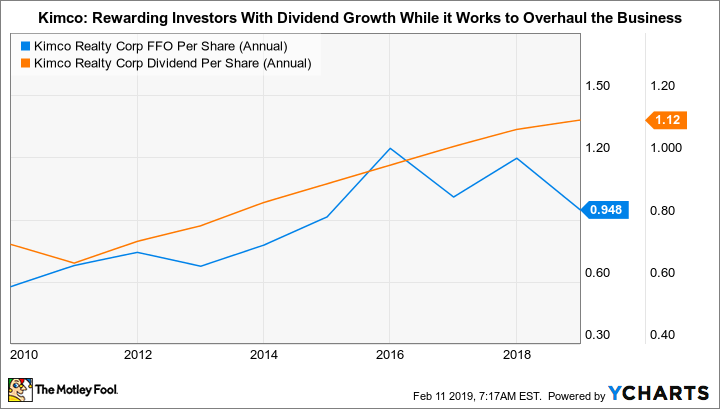
KIM FFO Per Share (Annual) Chart

KIM FFO Per Share (Annual) data by YCharts.

The only real problem here is that Kimco is currently paying out all of its funds available for distribution. Weak dividend coverage, however, has to be balanced against the company's growth plans. At present, management expects distribution coverage to start improving in 2020, with a longer-term payout target in the 80% range. With the success it has had so far in upgrading its portfolio, it deserves the benefit of the doubt here.

The best part

Kimco has spent the last few years creating a better portfolio. It has a pipeline of smaller projects that should keep the company growing, with a few larger projects that have additional risk but could really boost the value of the REIT's assets. Meanwhile, investors are worried about the changes facing the retail sector (which don't really have that big an impact on Kimco), the increased risk of the big projects, and the currently weak payout ratio. This has led to a fat 6%-plus yield and price to projected 2019 funds from operations, or FFO, of around 12.5 times. That looks like a very reasonable price to pay while you sit back, collect the big dividend, and watch Kimco continue its so-far-successful business makeover.

Sunday, February 17, 2019

Is Denison Mines a Buy?

Denison Mines (NYSEMKT:DNN) is working to build a new uranium mine in Canada. For investors interested in the nuclear fuel, it's an interesting stock to look at because of the material upside potential if construction plans play out as projected and uranium prices rise. But does that make it a stock worth buying? Only if you clearly understand the risks before putting your hard-saved capital into the shares. Here are some key facts you need to know before you invest here.

The good stuff

Denison's big asset is the Wheeler River project, which encompasses two potential uranium mines, Phoenix and Gryphon. In total, the company estimates that there are around 100 million pounds of uranium at the site. The two mines, meanwhile, are projected to have low operating costs. Phoenix's costs are expected to be as low as $3.33 per pound, while Gryphon is projected to have costs of around $11.70 per pound. Both are notably below the current uranium spot price of around $28 per pound.   

A man standing in the mouth of a mine with the sun behind him

Image source: Getty Images.

To help it get from the drawing board to an operating mine, meanwhile, Denison has a 22.5% interest in the McClean Lake Uranium mill. So, unlike many other upstart miners, Denison actually generates some revenue to help offset the costs of developing Wheeler River. Through the first nine months of 2018, McClean brought in roughly $8.6 million. 

Right now, Denison is projecting internal rates of return for the Wheeler project of between 38% and 67%, depending on future uranium prices. As for the balance sheet, it's pretty clean since Denison has no long-term debt weighing down its balance sheet. So far, Denison sounds like an interesting investment opportunity. But there's much more to understand before you buy Denison stock.   

The bad news

The biggest issue to consider with Denison Mines is time. Although the Wheeler River project sounds great, construction on the first of the two mines, Phoenix, isn't projected to start until 2021. It won't start producing uranium until 2024. Construction on Gryphon isn't projected to start until 2026, with first production in 2030. Being that it's 2019, there is a long time before these assets will contribute to cash flow. And that's if everything plays out as planned, which isn't a lock when dealing with the ground-up construction of a new mine. 

So, even if everything works out as hoped, Denison has years worth of expenses ahead of it. It will need to raise substantial capital to get these mines built. And, with a 90% ownership interest in the Wheeler Project, it's on the hook for most of the costs. The stake in the operating McClean Lake uranium mill is expected to help with that, but the company's operating expenses in the first nine months of 2018 were roughly $8.8 million compared to revenue of $8.6 million. The expense number's not exactly a clean one because you have to take into consideration things like depreciation, which is a non-cash expense, when you consider the benefit of the asset. But the bigger picture is that McClean Lake may help offset some mine development costs, but not a huge amount. 

DNN Average Diluted Shares Outstanding (Annual) Chart

DNN Average Diluted Shares Outstanding (Annual) data by YCharts.

So, despite the benefit of the McClean Lake mill, Denison will have to tap the capital markets for capital. Historically, that has meant selling stock, like it did in late 2018, when it issued roughly 4.95 million shares to raise around $3.8 million. Every one of those new shares dilutes current shareholders. With initial capital spending for Wheeler expected to be around $320 million, Denison is going to need to issue a lot more stock to get Phoenix and Gryphon up and running. Issuing debt is another option, but it would mean taking on the weight of the associated interest expenses. Another avenue would be for Denison to find a partner, which would mean giving up some of its ownership interest in the project. Simply put, getting from the drawing board to an operating uranium mine isn't going to be easy, financially speaking.   

Better options

Denison isn't a great investment choice for most investors despite the potential upside of the Wheeler River project. It is still early days, and there's a huge amount of spending that needs to be done, not to mention the inherent risks of building a mine (big projects like this don't always work out as planned once you put shovels in the ground). Only investors with very strong feelings about the uranium market and a deep understanding of this specific project should be looking here. Most investors looking at uranium would be much better off with a company like Cameco Corp. (NYSE:CCJ). This miner has operating mine assets and additional mines that are currently mothballed but that could be brought on line fairly quickly if there were enough demand. It's a similar story, but one that doesn't involve huge construction costs and risks.

Piper Jaffray Companies Equities Analysts Lift Earnings Estimates for Diamond Offshore Drilling Inc

Diamond Offshore Drilling Inc (NYSE:DO) – Investment analysts at Piper Jaffray Companies boosted their Q1 2019 earnings estimates for shares of Diamond Offshore Drilling in a report released on Monday, February 11th. Piper Jaffray Companies analyst I. Macpherson now expects that the offshore drilling services provider will post earnings of ($0.66) per share for the quarter, up from their previous forecast of ($0.67). Piper Jaffray Companies has a “Sell” rating and a $10.00 price objective on the stock. Piper Jaffray Companies also issued estimates for Diamond Offshore Drilling’s Q2 2019 earnings at ($0.58) EPS, Q3 2019 earnings at ($0.48) EPS, Q4 2019 earnings at ($0.30) EPS, FY2019 earnings at ($2.02) EPS, FY2020 earnings at ($1.89) EPS, FY2021 earnings at ($2.59) EPS and FY2022 earnings at ($0.68) EPS.

Get Diamond Offshore Drilling alerts:

Several other research firms also recently issued reports on DO. UBS Group upgraded Diamond Offshore Drilling from a “reduce” rating to an “accumulate” rating in a report on Thursday, October 18th. Clarkson Capital upgraded Diamond Offshore Drilling from a “neutral” rating to a “buy” rating and set a $16.00 price objective on the stock in a report on Thursday, November 8th. ValuEngine downgraded Diamond Offshore Drilling from a “strong-buy” rating to a “buy” rating in a report on Saturday, October 27th. Susquehanna Bancshares set a $16.00 price objective on Diamond Offshore Drilling and gave the company a “hold” rating in a report on Tuesday, November 6th. Finally, Wells Fargo & Co cut their price objective on Diamond Offshore Drilling from $22.00 to $17.00 and set a “market perform” rating on the stock in a report on Tuesday, November 6th. Nine equities research analysts have rated the stock with a sell rating, six have issued a hold rating and six have given a buy rating to the company. The company currently has a consensus rating of “Hold” and a consensus target price of $16.22.

DO stock opened at $9.60 on Thursday. The company has a current ratio of 3.91, a quick ratio of 3.91 and a debt-to-equity ratio of 0.54. The firm has a market capitalization of $1.31 billion, a P/E ratio of 11.71 and a beta of 1.63. Diamond Offshore Drilling has a 12-month low of $8.78 and a 12-month high of $21.92.

Diamond Offshore Drilling (NYSE:DO) last posted its earnings results on Monday, February 11th. The offshore drilling services provider reported ($0.42) EPS for the quarter, missing the Zacks’ consensus estimate of ($0.40) by ($0.02). Diamond Offshore Drilling had a negative net margin of 11.11% and a negative return on equity of 2.92%. The business had revenue of $232.50 million during the quarter, compared to analysts’ expectations of $249.89 million. During the same quarter in the prior year, the firm earned ($0.05) EPS. Diamond Offshore Drilling’s revenue for the quarter was down 32.8% compared to the same quarter last year.

Institutional investors and hedge funds have recently added to or reduced their stakes in the stock. Advisor Group Inc. grew its stake in Diamond Offshore Drilling by 108.3% during the 4th quarter. Advisor Group Inc. now owns 3,577 shares of the offshore drilling services provider’s stock worth $35,000 after purchasing an additional 1,860 shares in the last quarter. PNC Financial Services Group Inc. grew its stake in Diamond Offshore Drilling by 111.5% during the 4th quarter. PNC Financial Services Group Inc. now owns 4,681 shares of the offshore drilling services provider’s stock worth $44,000 after purchasing an additional 2,468 shares in the last quarter. Kentucky Retirement Systems acquired a new position in Diamond Offshore Drilling during the 3rd quarter worth $327,000. NumerixS Investment Technologies Inc acquired a new position in Diamond Offshore Drilling during the 4th quarter worth $61,000. Finally, Bessemer Group Inc. acquired a new position in Diamond Offshore Drilling during the 4th quarter worth $64,000.

About Diamond Offshore Drilling

Diamond Offshore Drilling, Inc provides contract drilling services to the energy industry worldwide. It provides services in floater market, including ultra-deepwater, deepwater, and mid-water. The company operates a fleet of 17 offshore drilling rigs, which comprises 4 drillships, 7 ultra-deepwater, 4 deepwater, and 2 mid-water semisubmersibles.

See Also: What is intrinsic value?

Earnings History and Estimates for Diamond Offshore Drilling (NYSE:DO)

Friday, February 15, 2019

Maduro Blames Trump For Venezuela's Great Depression

&l;p&g;&l;img class=&q;dam-image ap size-large wp-image-e327671cb6d642c88389dba615a3517b&q; src=&q;https://specials-images.forbesimg.com/dam/imageserve/e327671cb6d642c88389dba615a3517b/960x0.jpg?fit=scale&q; data-height=&q;640&q; data-width=&q;960&q;&g; Venezuela&a;rsquo;s President Nicolas Maduro speaks with Associated Press Vice President of International News, Ian Phillips, at Miraflores presidential palace in Caracas, Venezuela,on February 14, 2019. Even while criticizing Donald Trump&a;rsquo;s confrontational stance toward his socialist government, Maduro said he holds out hope of meeting the U.S. president to resolve an impasse over his recognition of opponent Juan Guaido as Venezuela&a;rsquo;s rightful leader. (AP Photo/Ariana Cubillos) photo credit: ASSOCIATED PRESS

Venezuela&a;rsquo;s president Nicolas Maduro has joined the #resistance. He blamed President Trump for his economic woes, saying in an Associated Press interview on Thursday that the country&a;rsquo;s ruling Socialists United of Venezuela (PSUV) will rebuild the country ... only if Trump stays away.

Which prompts&a;nbsp;the question, what was he waiting for before? The economy was swirling around the galactic blackhole before Trump was elected president.

Bonds were defaulted on at least a year before sanctions. They were also defaulted on despite the fact that Russia and China have been financing Venezuelan oil firm PdVSA&a;mdash;to no avail. Goldman Sachs even bought $2.8 billion worth of PdVSA bonds in 2017, helping secure the price.

Venezuela&a;rsquo;s economy has contracted for the last two years and will contract again this year, the first year Washington imposed sanctions on PdVSA oil and bond trading, a move that only went into effect last week.

&l;/p&g;&l;blockquote class=&q;twitter-tweet&q;&g; &l;p dir=&q;ltr&q; lang=&q;es&q;&g;&l;a href=&q;https://twitter.com/hashtag/EntrevistaAP?src=hash&a;amp;ref_src=twsrc%5Etfw&q; target=&q;_blank&q;&g;#EntrevistaAP&l;/a&g; El presidente de &l;a href=&q;https://twitter.com/hashtag/Venezuela?src=hash&a;amp;ref_src=twsrc%5Etfw&q; target=&q;_blank&q;&g;#Venezuela&l;/a&g; &l;a href=&q;https://twitter.com/NicolasMaduro?ref_src=twsrc%5Etfw&q; target=&q;_blank&q;&g;@NicolasMaduro&l;/a&g; revela conversaciones se cretas de su canciller con el enviado de EEUU &l;a href=&q;https://t.co/y9JVgzyUdf&q; target=&q;_blank&q;&g;https://t.co/y9JVgzyUdf&l;/a&g;&l;/p&g; &a;mdash; AP Noticias (@AP_Noticias) &l;a href=&q;https://twitter.com/AP_Noticias/status/1096395221535985665?ref_src=twsrc%5Etfw&q; target=&q;_blank&q;&g;February 15, 2019&l;/a&g;&l;/blockquote&g;

Venezuela&a;rsquo;s economic crisis has nothing to do with Washington, though Maduro and PSUV will work overtime making sure the electorate believes just the opposite.

Any CIA spooks roaming around in disguise did not create the PSUV disaster now unfolding. Despite years of recovering oil prices (from the $30s in 2016 to $55.31 today for WTI crude), Venezuela just keeps getting worse.

Central bank reserves, what the market knows of them, were just under $11 billion in 2017. Odds are&a;nbsp; they are not much better today. To put that into perspective, Brazil&a;rsquo;s foreign currency reserves are around $376 billion. Colombia has $47.7 billion in reserves.

&l;img class=&q;dam-image ap size-large wp-image-bb258c41f68e41ef8cb822b5b59103fe&q; src=&q;https://specials-images.forbesimg.com/dam/imageserve/bb258c41f68e41ef8cb822b5b59103fe/960x0.jpg?fit=scale&q; data-height=&q;639&q; data-width=&q;960&q;&g; Antigovernment protesters in Caracas on&a;nbsp;February 12, 2019. (AP Photo/Boris Vergara) photo credit: ASSOCIATED PRESS

Maduro has been doing the rounds with international media. Today it was the Associated Press story. Earlier this week, it was the BBC, where he said that humanitarian aid was a ploy by the U.S. to make his government look bad.

His government is at a crossroad. There are three routes to take.

One road has PSUV and the military continuing to rally around Maduro, keeping him in power in hopes to exhaust the opposition. Sanctions then make the economy worse, because after April 28 PdVSA is banned from selling crude oil to the U.S. Trump is even toying with extraterritorial sanctions, a potential death blow.

&l;img class=&q;dam-image ap size-large wp-image-72310df47a3549768bfbdf5181cf54f9&q; src=&q;https://specials-images.forbesimg.com/dam/imageserve/72310df47a3549768bfbdf5181cf54f9/960x0.jpg?fit=scale&q; data-height=&q;676&q; data-width=&q;960&q;&g; Venezuela&a;rsquo;s self-proclaimed interim president Juan Guaido. He says he supports U.S. military intervention, but such a radical move would set the table for more anti-American, and anti-capitalist revolutionary movements in Venezuela for many years to come. (AP Photo/Ariana Cubillos) photo credit: ASSOCIATED PRESS

The other option is that the PSUV leadership convinces Maduro to step down in order to save the party. Many people still support PSUV due to its founder, the late Hugo Chavez. There is a large enough portion of the electorate that view Maduro as the problem, not PSUV. In this option, PSUV remains in power but opens the door to allow for more sharing of power with the National Assembly.

The National Assembly president, Juan Guaido, is calling for new elections. He says Maduro can run in those elections. Maduro was re-elected in May 2018, but the Supreme Court disqualified key opposition figures from challenging him on the ballot. It would be like Joe Biden, Bernie Sanders, Kamala Harris, Elizabeth Warren and Beto O&a;rsquo;Rourke being banned from running against Trump in 2020.

The final option is for U.S. military intervention. Guaido supports this, but so far Congress has come out against it. Any effort by the U.S. government to put boots on the ground or support a coup with American military logistics would set the table for another Chavez character in the future.

&l;img class=&q;dam-image ap size-large wp-image-dcbdfe474832455a864484b422b9edf6&q; src=&q;https://specials-images.forbesimg.com/dam/imageserve/dcbdfe474832455a864484b422b9edf6/960x0.jpg?fit=scale&q; data-height=&q;639&q; data-width=&q;960&q;&g; Maduro tells the AP &a;ldquo;hands off Venezuela.&a;rdquo; The Socialists United are warning people through a new media campaign that Washington meddling in Venezuelan affairs will lead to a new Vietnam. (AP Photo/Ariana Cubillos) ASSOCIATED PRESS

Maduro&a;rsquo;s grip on power is weakening but not broken.

Barclays Capital analyst Alejandro Arreaza said in a note this week that he suspects PSUV will oust Maduro by April.

&l;p class=&q;tweet_line&q;&g;The next few weeks will say a lot about Maduro&a;rsquo;s hold on the presidency.&l;/p&g;

&a;ldquo;It seems difficult to believe that the Maduro regime and the corrupt ruling elite could withstand the pressure from the cash-flow shock post-sanctions as well as the increasing diplomatic pressure from the international community,&a;rdquo; says Siobhan Morden, a managing director at Nomura Securities in New York who has been watching this unfold for years.

Guaido claims that the military is fine with a political transition, but there have been no serious defections from the 2,000 generals in the Venezuelan army.

If the economic crisis doesn&a;rsquo;t provide sufficient motivation, then the Guaido team could shift towards closed-door negotiations with party and military leaders to reassure them amnesty and reconciliation in a post-PSUV government. (Think how the dismantling of the FARC went down in Colombia, for example.)

Meanwhile, Trump will warn of more threatening alternatives beyond extraterritorial sanctions. These include the targeting of offshore revenues and cutting off access to offshore assets.

&l;img class=&q;dam-image ap size-large wp-image-09c27768664e41e19de1da044ff7afd4&q; src=&q;https://specials-images.forbesimg.com/dam/imageserve/09c27768664e41e19de1da044ff7afd4/960x0.jpg?fit=scale&q; data-height=&q;640&q; data-width=&q;960&q;&g; A doll of Venezuela&a;rsquo;s late president Hugo Chavez with a flyer of&a;nbsp;current&a;nbsp;president Nicolas Maduro stuffed in its shirt and held aloft by a supporter during a pro-government demonstration this week. Many PSUV supporters see Maduro as the problem. Their loyalty to the party stems from their loyalty to Chavez. (AP Photo/Rodrigo Abd) photo credit: ASSOCIATED PRESS

&l;p class=&q;tweet_line&q;&g;Venezuela has become geopolitically relevant after two years of everyone watching it fall to pieces.&l;/p&g;

It is now a top priority for the Trump administration in Latin America, perhaps a close second to Mexico.

&a;ldquo;The only obvious strategy for the Maduro regime is resisting against increasing international and domestic pressure until the military reaches a breaking point,&a;rdquo; says Maduro. When that breaking point comes, then the option of PSUV convincing Maduro to walk is more plausible.

What happens in that transition remains the prerequisite for sanctions removal and the next phase of economic recovery.

Any recovery will include negotiations with bondholders before bigger financial aid packages can be made.

A &l;em&g;Financial Times&l;/em&g; article from Thursday titled&l;a href=&q;https://www.ft.com/topics/places/Venezuela&q; target=&q;_blank&q;&g;&a;nbsp;&a;ldquo;Venezuela&a;rsquo;s Collapse Eclipses Post-Soviet Crash&a;rdquo;&a;nbsp;&l;/a&g;says the 54% plunge in the country&s;s economic output is worse than what Russia faced in the early 1990s. With no money to speak of, an 80% haircut on PdVSA and Venezuela bonds is&a;nbsp;the worst-case scenario.

American bondholders of Venezuelan debt can only sell those bonds to non-U.S. individuals and entities. For some long term holders it is liquidate and lock in a loss, while short-term holders who have been buying PdVSA bonds at distressed levels need to wait and see what happens to the price after debt negotiations.

&a;ldquo;We&a;rsquo;re not in and glad we stayed out,&a;rdquo; says Katherine Renfrew, a bond fund manager for TIAA Investments. &a;ldquo;It&a;rsquo;s going to take a long time for Venezuela&a;rsquo;s economy to recover from this one.&a;rdquo;

&a;nbsp;

&a;nbsp;

Thursday, February 14, 2019

Top 10 Warren Buffett Stocks To Invest In Right Now

tags:BRD,MMYT,PEG,ATAX,SOHU,ISRG,LBTYA,CJJD,TEL,AIV, &l;p&g;&l;img class=&q;dam-image getty size-large wp-image-913110766&q; src=&q;https://specials-images.forbesimg.com/dam/imageserve/913110766/960x0.jpg?fit=scale&q; data-height=&q;646&q; data-width=&q;960&q;&g; A woman dressed in a t-shirt with cryptocurrency logos shows a visual representation of the cryptocurrency Bitcoin and other cryptocurrencies. Photo by Chesnot/Getty Images

Bitcoin had been on an uptrend since April 12 when it hit a recent low of $6,850. Tom Lee, Head of Research at Fundstrat, had postulated that at least part of the weakness in Bitcoin and other cryptocurrencies in March and the first two weeks of April had been due to &l;a href=&q;http://www.forbes.com/sites/chuckjones/2018/04/22/bitcoin-continues-rebounding-after-april-17-tax-day/&q;&g;investors selling them to raise cash to pay for 2017 gains&l;/a&g;.

It got as high as $9,950 on Saturday, May 5, but later in the day it started moving lower which seemed to be about the same time that Warren Buffett and Charlie Munger at the Berkshire Hathaway&a;rsquo;s shareholder meeting &l;a href=&q;http://www.forbes.com/sites/chuckjones/2018/05/07/warren-buffett-stalls-bitcoins-advance-just-short-of-10000/&q;&g;made multiple statements denigrating it&l;/a&g;. It fell to $9,300 last Sunday and essentially traded between $9,000 to $9,400 until Thursday evening. On Friday it broke down and fell to $8,300.

Top 10 Warren Buffett Stocks To Invest In Right Now: Apollo Gold Corporation(BRD)

Advisors' Opinion:
  • [By Ethan Ryder]

    Bread (CURRENCY:BRD) traded 10.1% lower against the U.S. dollar during the 24-hour period ending at 15:00 PM ET on May 6th. Bread has a market cap of $73.13 million and approximately $1.09 million worth of Bread was traded on exchanges in the last 24 hours. One Bread token can currently be purchased for about $0.82 or 0.00008683 BTC on popular exchanges including OKEx, Binance and Cobinhood. In the last seven days, Bread has traded 3.3% higher against the U.S. dollar.

  • [By Max Byerly]

    Bread (CURRENCY:BRD) traded 0% higher against the US dollar during the 24 hour period ending at 0:00 AM E.T. on February 12th. Bread has a market capitalization of $17.44 million and $74,926.00 worth of Bread was traded on exchanges in the last day. In the last week, Bread has traded 6.8% higher against the US dollar. One Bread token can currently be purchased for $0.20 or 0.00005397 BTC on major cryptocurrency exchanges including Cobinhood, OKEx, Tokenomy and Kucoin.

  • [By Joseph Griffin]

    Bread (CURRENCY:BRD) traded 2.1% lower against the U.S. dollar during the 24-hour period ending at 21:00 PM Eastern on May 27th. One Bread token can currently be bought for $0.46 or 0.00006320 BTC on popular cryptocurrency exchanges including Cobinhood, Binance and OKEx. Bread has a market capitalization of $40.78 million and $4.40 million worth of Bread was traded on exchanges in the last day. During the last seven days, Bread has traded down 28.2% against the U.S. dollar.

  • [By Ethan Ryder]

    Bread (CURRENCY:BRD) traded up 12.2% against the U.S. dollar during the one day period ending at 15:00 PM E.T. on September 20th. In the last week, Bread has traded 17.1% higher against the U.S. dollar. Bread has a total market capitalization of $32.97 million and approximately $760,371.00 worth of Bread was traded on exchanges in the last day. One Bread token can now be bought for approximately $0.37 or 0.00005774 BTC on major cryptocurrency exchanges including Kucoin, Tokenomy, OKEx and Cobinhood.

  • [By Max Byerly]

    Bread (CURRENCY:BRD) traded up 0.8% against the US dollar during the twenty-four hour period ending at 22:00 PM Eastern on September 1st. Over the last week, Bread has traded 3.1% higher against the US dollar. Bread has a market cap of $32.33 million and $367,357.00 worth of Bread was traded on exchanges in the last day. One Bread token can currently be purchased for about $0.36 or 0.00005097 BTC on major cryptocurrency exchanges including Kucoin, Cobinhood, Binance and OKEx.

Top 10 Warren Buffett Stocks To Invest In Right Now: MakeMyTrip Limited(MMYT)

Advisors' Opinion:
  • [By Shane Hupp]

    Nomura upgraded shares of MakeMyTrip (NASDAQ:MMYT) from a reduce rating to a neutral rating in a report issued on Monday morning, Marketbeat reports.

  • [By Max Byerly]

    TheStreet lowered shares of MakeMyTrip (NASDAQ:MMYT) from a c- rating to a d+ rating in a report published on Tuesday.

    Other equities research analysts also recently issued reports about the stock. Jefferies Financial Group raised shares of MakeMyTrip from a hold rating to a buy rating and set a $19.80 price target for the company in a research note on Wednesday, August 15th. BidaskClub downgraded shares of MakeMyTrip from a strong-buy rating to a buy rating in a research note on Wednesday, June 20th. Zacks Investment Research raised shares of MakeMyTrip from a hold rating to a buy rating and set a $45.00 price target for the company in a research note on Friday, June 15th. Bank of America dropped their price target on shares of MakeMyTrip from $40.00 to $39.50 and set a buy rating for the company in a research note on Monday, July 9th. Finally, ValuEngine downgraded shares of MakeMyTrip from a buy rating to a hold rating in a research note on Thursday, September 6th. One equities research analyst has rated the stock with a sell rating, four have assigned a hold rating and three have issued a buy rating to the company’s stock. The company presently has a consensus rating of Hold and an average target price of $36.36.

  • [By Lisa Levin] Companies Reporting Before The Bell Dick's Sporting Goods, Inc. (NYSE: DKS) is projected to report its quarterly earnings at $0.45 per share on revenue of $1.89 billion. Columbus McKinnon Corporation (NASDAQ: CMCO) is estimated to report its quarterly earnings at $0.5 per share on revenue of $209.35 million. Analog Devices, Inc. (NASDAQ: ADI) is expected to report its quarterly earnings at $1.38 per share on revenue of $1.47 billion. Michael Kors Holdings Limited (NYSE: KORS) is projected to report its quarterly earnings at $0.59 per share on revenue of $1.15 billion. Movado Group, Inc. (NYSE: MOV) is expected to report its quarterly earnings at $0.11 per share on revenue of $109.47 million. Chico's FAS, Inc. (NYSE: CHS) is estimated to report its quarterly earnings at $0.26 per share on revenue of $552.31 million. DSW Inc. (NYSE: DSW) is projected to report its quarterly earnings at $0.37 per share on revenue of $681.89 million. Daktronics, Inc. (NASDAQ: DAKT) is expected to report its quarterly earnings at $0.05 per share on revenue of $147.20 million. Destination XL Group, Inc. (NASDAQ: DXLG) is estimated to report a quarterly loss at $0.14 per share on revenue of $107.63 million. Bank of Montreal (NYSE: BMO) is expected to report its quarterly earnings at $1.67 per share on revenue of $4.21 billion. MakeMyTrip Limited (NASDAQ: MMYT) is projected to report its quarterly loss at $0.39 per share on revenue of $143.03 million. EVINE Live Inc. (NASDAQ: EVLV) is expected to report its quarterly loss at $0.02 per share on revenue of $155.98 million. RBC Bearings Incorporated (NASDAQ: ROLL) is estimated to report its quarterly earnings at $1.14 per share on revenue of $175.55 million.


  • [By Neha Chamaria]

    Berkshire Hathaway isn't just betting on a digital payments company: Paytm's torrid growth reminds me of Amazon and how it wants to be pretty much everywhere. To give you an idea, here are just some of the areas Paytm has already made forays into:

    Paytm Wallet -- offers a gamut of wallet services, including travel, event, and entertainment ticketing. Paytm claims to sell nearly 4 million air, rail, and bus tickets monthly, giving India's largest online travel aggregator, MakeMyTrip (NASDAQ:MMYT) a run for its money. For perspective, MakeMyTrip sold around 72.9 million air and bus tickets in fiscal 2018. Paytm aims to double its ticketing volumes in fiscal 2019. On a separate note, Softbank (NASDAQOTH:SFTBY) -- one of Paytm's stakeholders -- is teaming up with the company to launch digital payment services in Japan. Paytm Mall -- already the third-largest e-commerce company in India after Amazon and Flipkart. Paytm Mall generated annualized gross sales worth $3.5 billion in June, according to Livemint; the company is targeting $10 billion in annualized sales by March 2019. Alphabet's Google is now reportedly eyeing a partnership with Paytm Mall to buy a stake in India's largest retailer, Future Group, and join the hot hypermarket and online-grocery race in India. Paytm Payments Bank -- one of only 11 such banks in India to get a payments bank license. This allows it to offer restricted banking services such as low-cost savings accounts, deposits, cards, and fund transfers, primarily targeting India's "unbanked and underbanked" population. Paytm Money -- a mutual fund distribution platform that will start operations soon. Financial services -- expanded offerings including loans, insurance, gold, and foreign exchange. Paytm aims to become the world's "largest digital bank," with 500 million accounts, according to Bloomberg. Paytm Inbox -- a messaging service app akin to Facebook's WhatsApp that also allows money transfer, and will soon offer live television, ga
  • [By Stephan Byrd]

    Get a free copy of the Zacks research report on MakeMyTrip (MMYT)

    For more information about research offerings from Zacks Investment Research, visit Zacks.com

  • [By Max Byerly]

    MakeMyTrip (NASDAQ: MMYT) and Yatra Online (NASDAQ:YTRA) are both computer and technology companies, but which is the better business? We will compare the two businesses based on the strength of their dividends, profitability, valuation, analyst recommendations, institutional ownership, earnings and risk.

Top 10 Warren Buffett Stocks To Invest In Right Now: Public Service Enterprise Group Incorporated(PEG)

Advisors' Opinion:
  • [By Ethan Ryder]

    ValuEngine upgraded shares of Public Service Enterprise Group (NYSE:PEG) from a hold rating to a buy rating in a research report report published on Tuesday morning.

  • [By Logan Wallace]

    Analysts expect that Pattern Energy Group Inc (NASDAQ:PEGI) (TSE:PEG) will post $143.93 million in sales for the current quarter, according to Zacks. Three analysts have provided estimates for Pattern Energy Group’s earnings, with the lowest sales estimate coming in at $137.60 million and the highest estimate coming in at $147.50 million. Pattern Energy Group reported sales of $110.72 million in the same quarter last year, which would suggest a positive year over year growth rate of 30%. The company is scheduled to issue its next quarterly earnings results on Thursday, March 7th.

  • [By Stephan Byrd]

    Baird Financial Group Inc. lowered its stake in shares of Public Service Enterprise Group Inc. (NYSE:PEG) by 6.0% in the second quarter, HoldingsChannel reports. The institutional investor owned 30,164 shares of the utilities provider’s stock after selling 1,930 shares during the quarter. Baird Financial Group Inc.’s holdings in Public Service Enterprise Group were worth $1,633,000 as of its most recent SEC filing.

  • [By Stephan Byrd]

    Brokerages expect Pattern Energy Group Inc (NASDAQ:PEGI) (TSE:PEG) to post $0.02 earnings per share (EPS) for the current fiscal quarter, Zacks Investment Research reports. Three analysts have provided estimates for Pattern Energy Group’s earnings, with estimates ranging from ($0.17) to $0.19. Pattern Energy Group posted earnings per share of ($0.26) during the same quarter last year, which indicates a positive year over year growth rate of 107.7%. The company is expected to report its next quarterly earnings results on Thursday, November 8th.

  • [By Max Byerly]

    Media headlines about Public Service (NYSE:PEG) have trended somewhat positive recently, according to Accern. The research firm identifies negative and positive press coverage by analyzing more than twenty million news and blog sources. Accern ranks coverage of public companies on a scale of -1 to 1, with scores nearest to one being the most favorable. Public Service earned a media sentiment score of 0.04 on Accern’s scale. Accern also gave headlines about the utilities provider an impact score of 46.5923185859882 out of 100, meaning that recent press coverage is somewhat unlikely to have an impact on the stock’s share price in the near future.

  • [By Ethan Ryder]

    Pattern Energy Group Inc (NASDAQ:PEGI) (TSE:PEG) insider Esben W. Pedersen sold 1,200 shares of the company’s stock in a transaction on Tuesday, September 4th. The stock was sold at an average price of $20.40, for a total transaction of $24,480.00. Following the completion of the transaction, the insider now directly owns 159,027 shares in the company, valued at approximately $3,244,150.80. The transaction was disclosed in a filing with the Securities & Exchange Commission, which is accessible through the SEC website.

Top 10 Warren Buffett Stocks To Invest In Right Now: America First Tax Exempt Investors L.P.(ATAX)

Advisors' Opinion:
  • [By Motley Fool Transcribers]

    America First Multifamily Investors LP (NASDAQ:ATAX)Q2 2018 Earnings Conference CallAug. 13, 2018, 4:30 p.m. ET

    Contents: Prepared Remarks Questions and Answers Call Participants Prepared Remarks:

    Operator

  • [By Shane Hupp]

    Get a free copy of the Zacks research report on America First Multifamily Investors (ATAX)

    For more information about research offerings from Zacks Investment Research, visit Zacks.com

  • [By Max Byerly]

    Get a free copy of the Zacks research report on America First Multifamily Investors (ATAX)

    For more information about research offerings from Zacks Investment Research, visit Zacks.com

  • [By Shane Hupp]

    America First Multifamily Investors LP (NASDAQ:ATAX) Director Lisa Y. Roskens bought 5,965 shares of the stock in a transaction that occurred on Monday, August 27th. The shares were purchased at an average price of $5.95 per share, for a total transaction of $35,491.75. Following the purchase, the director now owns 100,069 shares in the company, valued at approximately $595,410.55. The acquisition was disclosed in a filing with the Securities & Exchange Commission, which can be accessed through this link.

Top 10 Warren Buffett Stocks To Invest In Right Now: Sohu.com Inc.(SOHU)

Advisors' Opinion:
  • [By Anders Bylund]

    Sogou's shares are prone to big swings for a couple of simple reasons.

    As a Chinese business, many American investors don't feel connected to Sogou's business and might not have access to some important sources of information about this company and its stock. Though Sogou has been around for nearly a decade now, it only entered the public markets in November of 2017. It's a new ticker, untested on the market, and not always easily understood through year-over-year or longer-term analyses. At the IPO, Chinese internet giants Tencent (NASDAQOTH:TCEHY) and Sohu.com (NASDAQ:SOHU) combined for a total ownership of 82% of Sogu's business. Those stakes later declined to 71%, but Sohu and Tencent remain Sogou's largest shareholders, with 96% of the voting power in shareholder elections and votes. Regular investors hold a very small stake in Sogou, which tends to boost the stock's volatility.

    Moreover, Chinese regulators launched an investigation of Sogou in June, forcing the company to shut down parts of its online advertising operations for 10 days in early July. The company is accused of showing video ads that insulted a national hero. That blackout will reduce Sogou's third-quarter revenues by a significant but unannounced amount.

  • [By Rick Munarriz]

    The market isn't warming up to Sohu.com's (NASDAQ:SOHU) latest financial report. Its shares are hitting their lowest levels since the summer of 2007 after the Chinese online advertising, search, and gaming specialist posted disappointing first-quarter results on Wednesday morning. 

  • [By Rick Munarriz]

    Lumber Liquidators (NYSE:LL), Camping World Holdings (NYSE:CWH), and Sohu.com (NASDAQ:SOHU) have taken a beating this year. They're among the biggest losers through the first three quarters of 2018. Let's go over why I think they have a shot at bouncing back in the next three months.

  • [By Daniel Sparks]

    Shares of Chinese internet company Sohu.com (NASDAQ:SOHU) fell as much as 11.8% on Wednesday, following the company's first-quarter earnings release. The stock is down 8.4% at the time of this writing.

  • [By Rick Munarriz]

    Sohu.com (NASDAQ:SOHU) is still struggling to fire on all cylinders, but investors nonetheless bid shares of the dot-com pioneer higher on Friday after it posted mixed fourth-quarter results. Revenue clocked in at $482.2 million for the final three months of 2018, a 5% decline from a year earlier, but a 5% sequential improvement. 

  • [By Joseph Griffin]

    Russell Investments Group Ltd. decreased its holdings in shares of Sohu com Ltd (NASDAQ:SOHU) by 23.4% in the first quarter, HoldingsChannel.com reports. The fund owned 108,393 shares of the information services provider’s stock after selling 33,178 shares during the quarter. Russell Investments Group Ltd.’s holdings in Sohu com were worth $3,351,000 as of its most recent filing with the Securities and Exchange Commission (SEC).

Top 10 Warren Buffett Stocks To Invest In Right Now: Intuitive Surgical Inc.(ISRG)

Advisors' Opinion:
  • [By Keith Speights]

    It isn't likely that Alphabet is concerned in the least about J&J's acquisition of Auris Health. But it could be a different story for the current leader in robotic surgery, Intuitive Surgical (NASDAQ:ISRG).

  • [By Brian Stoffel]

    That's because these three companies -- Amazon (NASDAQ:AMZN), Alphabet (NASDAQ:GOOG) (NASDAQ:GOOGL), and Intuitive Surgical (NASDAQ:ISRG) -- share the three characteristics I value above all else in my portfolio: a wide and defendable moat, multiple ways of growing their businesses moving forward, and stellar balance sheets.

  • [By Motley Fool Staff]

    Intuitive Surgical (NASDAQ:ISRG) reported fourth-quarter earnings and it delivered a small miss on profits. Wall Street, no shock, dinged its stock price accordingly.

  • [By Brian Feroldi]

    Medtronic (NYSE:MDT) and Intuitive Surgical (NASDAQ:ISRG) are two of the most successful medical device companies of all time.

    Medtronic has been hawking medical devices since it was founded in 1949, and it has been a stellar long-term investment. The company has turned into such a steady-eddy business that it has raised its dividend for 41 years in a row.

Top 10 Warren Buffett Stocks To Invest In Right Now: Liberty Global plc(LBTYA)

Advisors' Opinion:
  • [By Joseph Griffin]

    Epoch Investment Partners Inc. grew its position in shares of Liberty Global PLC Class A (NASDAQ:LBTYA) by 1.1% during the first quarter, according to the company in its most recent 13F filing with the Securities & Exchange Commission. The fund owned 2,946,065 shares of the company’s stock after buying an additional 31,331 shares during the period. Epoch Investment Partners Inc. owned about 0.36% of Liberty Global PLC Class A worth $92,241,000 as of its most recent SEC filing.

  • [By Stephan Byrd]

    Liberty Global (NASDAQ: LBTYA) is one of 32 public companies in the “Cable & other pay television services” industry, but how does it contrast to its competitors? We will compare Liberty Global to related companies based on the strength of its institutional ownership, analyst recommendations, dividends, valuation, risk, profitability and earnings.

  • [By Joseph Griffin]

    Diamond Hill Capital Management Inc. grew its holdings in shares of Liberty Global PLC Class A (NASDAQ:LBTYA) by 37.0% during the 2nd quarter, according to its most recent filing with the Securities and Exchange Commission. The institutional investor owned 515,191 shares of the company’s stock after buying an additional 139,156 shares during the quarter. Diamond Hill Capital Management Inc.’s holdings in Liberty Global PLC Class A were worth $14,188,000 at the end of the most recent reporting period.

  • [By Joseph Griffin]

    Barclays reiterated their buy rating on shares of Liberty Global (NASDAQ:LBTYA) in a report released on Sunday. They currently have a $39.00 target price on the stock.

  • [By Ethan Ryder]

    Liberty Global PLC Class A (NASDAQ:LBTYA) was the target of some unusual options trading activity on Monday. Investors acquired 1,977 put options on the company. This is an increase of approximately 1,312% compared to the average daily volume of 140 put options.

  • [By Ethan Ryder]

    BidaskClub cut shares of Liberty Global (NASDAQ:LBTYA) from a hold rating to a sell rating in a report released on Tuesday.

    LBTYA has been the topic of a number of other research reports. Jefferies Group reiterated a buy rating on shares of Liberty Global in a research report on Thursday, March 15th. Sanford C. Bernstein upgraded Liberty Global from a market perform rating to an outperform rating and set a $41.00 price objective on the stock in a research report on Wednesday, March 14th. ValuEngine downgraded Liberty Global from a sell rating to a strong sell rating in a research report on Thursday, March 1st. Citigroup set a $43.00 price objective on Liberty Global and gave the stock a buy rating in a research report on Thursday, February 22nd. Finally, Macquarie reiterated an outperform rating and set a $45.00 price objective (up previously from $41.00) on shares of Liberty Global in a research report on Friday, February 16th. Three research analysts have rated the stock with a sell rating, two have assigned a hold rating and twelve have given a buy rating to the company. The company presently has an average rating of Buy and a consensus target price of $41.46.

Top 10 Warren Buffett Stocks To Invest In Right Now: China Jo-Jo Drugstores, Inc.(CJJD)

Advisors' Opinion:
  • [By Shane Hupp]

    Press coverage about China Jo-Jo Drugstores (NASDAQ:CJJD) has trended positive on Saturday, Accern reports. Accern identifies negative and positive media coverage by analyzing more than twenty million news and blog sources in real time. Accern ranks coverage of companies on a scale of negative one to positive one, with scores nearest to one being the most favorable. China Jo-Jo Drugstores earned a media sentiment score of 0.28 on Accern’s scale. Accern also assigned press coverage about the company an impact score of 48.5554072096128 out of 100, meaning that recent media coverage is somewhat unlikely to have an impact on the company’s share price in the next several days.

Top 10 Warren Buffett Stocks To Invest In Right Now: TE Connectivity Ltd.(TEL)

Advisors' Opinion:
  • [By Logan Wallace]

    Robeco Institutional Asset Management B.V. lifted its stake in shares of TE Connectivity Ltd. (NYSE:TEL) by 0.9% during the 1st quarter, according to its most recent 13F filing with the Securities and Exchange Commission. The fund owned 1,295,222 shares of the electronics maker’s stock after purchasing an additional 10,957 shares during the quarter. Robeco Institutional Asset Management B.V.’s holdings in TE Connectivity were worth $129,394,000 as of its most recent filing with the Securities and Exchange Commission.

  • [By Ethan Ryder]

    TE Connectivity Ltd (NYSE:TEL) has been given a consensus recommendation of “Buy” by the fourteen research firms that are covering the stock, Marketbeat.com reports. One research analyst has rated the stock with a sell recommendation, four have issued a hold recommendation and nine have issued a buy recommendation on the company. The average 1 year target price among brokers that have updated their coverage on the stock in the last year is $114.30.

  • [By Max Byerly]

    Allianz Asset Management GmbH raised its stake in TE Connectivity Ltd (NYSE:TEL) by 16.3% in the 1st quarter, according to the company in its most recent filing with the Securities and Exchange Commission (SEC). The firm owned 1,613,642 shares of the electronics maker’s stock after buying an additional 225,677 shares during the period. Allianz Asset Management GmbH owned about 0.46% of TE Connectivity worth $161,202,000 as of its most recent filing with the Securities and Exchange Commission (SEC).

  • [By Logan Wallace]

    United Capital Financial Advisers LLC boosted its position in TE Connectivity Ltd (NYSE:TEL) by 18.5% during the 1st quarter, HoldingsChannel reports. The fund owned 11,098 shares of the electronics maker’s stock after acquiring an additional 1,736 shares during the quarter. United Capital Financial Advisers LLC’s holdings in TE Connectivity were worth $1,109,000 as of its most recent SEC filing.

  • [By Max Byerly]

    Achmea Investment Management B.V. increased its stake in TE Connectivity Ltd (NYSE:TEL) by 2.9% during the first quarter, according to its most recent 13F filing with the Securities and Exchange Commission. The institutional investor owned 235,540 shares of the electronics maker’s stock after purchasing an additional 6,726 shares during the quarter. Achmea Investment Management B.V. owned approximately 0.07% of TE Connectivity worth $18,665,000 as of its most recent filing with the Securities and Exchange Commission.

Top 10 Warren Buffett Stocks To Invest In Right Now: Apartment Investment and Management Company(AIV)

Advisors' Opinion:
  • [By Max Byerly]

    Apartment Investment and Management (NYSE:AIV) had its hold rating reiterated by analysts at BMO Capital Markets. They currently have a $47.00 price target on the stock.

  • [By Ethan Ryder]

    These are some of the headlines that may have effected Accern’s scoring:

    Get Apartment Investment and Management alerts: Jefferies Financial Group Initiates Coverage on Apartment Investment and Management (AIV) (americanbankingnews.com) Free Research Report as Apartment Investment and Management's AFFO Rose 6% (finance.yahoo.com) $245.43 Million in Sales Expected for Apartment Investment and Management Co (AIV) This Quarter (americanbankingnews.com) $0.61 EPS Expected for Apartment Investment and Management Co (AIV) This Quarter (americanbankingnews.com) Apartment Investment and Management (AIV) PT Raised to $48.00 (americanbankingnews.com)

    AIV has been the topic of a number of research reports. Zacks Investment Research lowered shares of Apartment Investment and Management from a “hold” rating to a “sell” rating in a research note on Monday, February 19th. BMO Capital Markets raised shares of Apartment Investment and Management from an “underperform” rating to a “market perform” rating and set a $42.00 target price on the stock in a research note on Friday, March 2nd. SunTrust Banks set a $44.00 target price on shares of Apartment Investment and Management and gave the company a “buy” rating in a research note on Friday, March 2nd. Barclays reaffirmed a “buy” rating and set a $48.00 target price on shares of Apartment Investment and Management in a research note on Tuesday, March 13th. Finally, Zelman & Associates lowered shares of Apartment Investment and Management from a “hold” rating to a “sell” rating in a research note on Thursday, May 10th. Two analysts have rated the stock with a sell rating, nine have assigned a hold rating and four have given a buy rating to the stock. The company currently has a consensus rating of “Hold” and a consensus target price of $46.00.

  • [By Ethan Ryder]

    Apartment Investment and Management (NYSE:AIV)‘s stock had its “hold” rating reiterated by equities researchers at BMO Capital Markets in a research report issued on Thursday. They currently have a $44.00 price target on the real estate investment trust’s stock. BMO Capital Markets’ price target suggests a potential upside of 3.92% from the company’s current price.

  • [By Shane Hupp]

    Apartment Investment and Management Co (NYSE:AIV) CEO Terry Considine sold 100,000 shares of the company’s stock in a transaction dated Monday, February 11th. The shares were sold at an average price of $49.28, for a total transaction of $4,928,000.00. Following the sale, the chief executive officer now owns 378,365 shares of the company’s stock, valued at $18,645,827.20. The transaction was disclosed in a filing with the Securities & Exchange Commission, which is available through the SEC website.

Wednesday, February 13, 2019

Huge Johnson & Johnson Acquisition Targets Robotics

On Wednesday, Johnson & Johnson (NYSE: JNJ) announced that its subsidiary, Ethicon, had entered a definitive agreement to acquire Auris Health, a robotic technology firm, initially focused on lung cancer.

Management believes this acquisition will accelerate Johnson & Johnson’s entry into robotics, with potential for growth and expansion into other interventional applications.

Under the terms of the agreement, Ethicon is acquiring Auris for approximately $3.4 billion in cash. Additional contingent payments of up to $2.35 billion, in the aggregate, may be payable upon reaching certain predetermined milestones.

Johnson & Johnson is creating a connected digital ecosystem centered around using data to improve patient outcomes that leverages world-class robotic technology. This ecosystem will empower patients to take charge of their health, guide surgeons through procedures and help them advance their skills and enable health care systems to deliver more consistent procedures while also managing costs.

The transaction is expected to close by the end of the second quarter of 2019.

Ashley McEvoy, executive vice president and worldwide chair of Johnson & Johnson’s Medical Devices unit, commented:

In this new era of health care, we’re aiming to simplify surgery, drive efficiency, reduce complications and improve outcomes for patients, ultimately making surgery safer. We believe the combination of best-in-class robotics, advanced instrumentation and unparalleled end-to-end connectivity will make a meaningful difference in patient outcomes.

Shares of Johnson & Johnson were last seen trading at $134.61, in a 52-week range of $118.62 to $148.99. The consensus analyst price target is $144.22.

24/7 Wall St.
The 15 Best Dividend Stocks for Retirees to Own

Tuesday, February 12, 2019

Contrasting CyrusOne (CONE) and Manhattan Bridge Capital (LOAN)

CyrusOne (NASDAQ:CONE) and Manhattan Bridge Capital (NASDAQ:LOAN) are both finance companies, but which is the superior stock? We will contrast the two companies based on the strength of their institutional ownership, profitability, analyst recommendations, risk, dividends, earnings and valuation.

Valuation and Earnings

Get CyrusOne alerts:

This table compares CyrusOne and Manhattan Bridge Capital’s top-line revenue, earnings per share (EPS) and valuation.

Gross Revenue Price/Sales Ratio Net Income Earnings Per Share Price/Earnings Ratio
CyrusOne $672.00 million 8.58 -$83.50 million $3.12 17.46
Manhattan Bridge Capital $5.92 million 9.95 $3.43 million N/A N/A

Manhattan Bridge Capital has lower revenue, but higher earnings than CyrusOne.

Risk and Volatility

CyrusOne has a beta of 0.89, suggesting that its stock price is 11% less volatile than the S&P 500. Comparatively, Manhattan Bridge Capital has a beta of 0.56, suggesting that its stock price is 44% less volatile than the S&P 500.

Analyst Ratings

This is a summary of current ratings and target prices for CyrusOne and Manhattan Bridge Capital, as provided by MarketBeat.

Sell Ratings Hold Ratings Buy Ratings Strong Buy Ratings Rating Score
CyrusOne 0 5 8 0 2.62
Manhattan Bridge Capital 0 0 1 0 3.00

CyrusOne currently has a consensus price target of $66.24, indicating a potential upside of 21.63%. Manhattan Bridge Capital has a consensus price target of $8.00, indicating a potential upside of 31.15%. Given Manhattan Bridge Capital’s stronger consensus rating and higher probable upside, analysts clearly believe Manhattan Bridge Capital is more favorable than CyrusOne.

Insider & Institutional Ownership

98.0% of CyrusOne shares are held by institutional investors. Comparatively, 17.1% of Manhattan Bridge Capital shares are held by institutional investors. 1.4% of CyrusOne shares are held by insiders. Comparatively, 32.4% of Manhattan Bridge Capital shares are held by insiders. Strong institutional ownership is an indication that endowments, hedge funds and large money managers believe a stock will outperform the market over the long term.

Profitability

This table compares CyrusOne and Manhattan Bridge Capital’s net margins, return on equity and return on assets.

Net Margins Return on Equity Return on Assets
CyrusOne 14.07% 5.68% 2.32%
Manhattan Bridge Capital 58.13% 15.54% 7.68%

Dividends

CyrusOne pays an annual dividend of $1.84 per share and has a dividend yield of 3.4%. Manhattan Bridge Capital pays an annual dividend of $0.48 per share and has a dividend yield of 7.9%. CyrusOne pays out 59.0% of its earnings in the form of a dividend. CyrusOne has raised its dividend for 5 consecutive years and Manhattan Bridge Capital has raised its dividend for 3 consecutive years.

Summary

Manhattan Bridge Capital beats CyrusOne on 10 of the 16 factors compared between the two stocks.

CyrusOne Company Profile

CyrusOne (NASDAQ: CONE) is a high-growth real estate investment trust (REIT) specializing in highly reliable enterprise-class, carrier-neutral data center properties. The Company provides mission-critical data center facilities that protect and ensure the continued operation of IT infrastructure for approximately 1,000 customers, including 208 Fortune 1000 companies. With a track record of meeting and surpassing the aggressive speed-to-market demands of hyperscale cloud providers, as well as the expanding IT infrastructure requirements of the enterprise, CyrusOne provides the flexibility, reliability, security, and connectivity that foster business growth. CyrusOne offers a tailored, customer service-focused platform and is committed to full transparency in communication, management, and service delivery throughout its 47 data centers worldwide.
Manhattan Bridge Capital Company Profile

Manhattan Bridge Capital, Inc., a real estate finance company, originates, services, and manages a portfolio of first mortgage loans in the United States. It offers short-term, secured, and non-banking loans to real estate investors to fund their acquisition, renovation, rehabilitation, or enhancement of properties in the New York metropolitan area. The company's loans are principally secured by collateral consisting of real estate and accompanied by personal guarantees from the principals of the businesses. It qualifies as a real estate investment trust for federal income tax purposes. The company generally would not be subject to federal corporate income taxes if it distributes at least 90% of its taxable income to its stockholders. Manhattan Bridge Capital, Inc. was founded in 1989 and is headquartered in Great Neck, New York.

Ooma Inc (OOMA) Expected to Announce Earnings of -$0.05 Per Share

Analysts expect that Ooma Inc (NYSE:OOMA) will post earnings of ($0.05) per share for the current fiscal quarter, according to Zacks. Three analysts have provided estimates for Ooma’s earnings. Ooma reported earnings of ($0.03) per share during the same quarter last year, which would suggest a negative year-over-year growth rate of 66.7%. The firm is scheduled to issue its next quarterly earnings report after the market closes on Tuesday, March 5th.

On average, analysts expect that Ooma will report full-year earnings of ($0.17) per share for the current financial year, with EPS estimates ranging from ($0.18) to ($0.17). For the next fiscal year, analysts expect that the company will post earnings of ($0.05) per share, with EPS estimates ranging from ($0.13) to $0.01. Zacks’ EPS averages are an average based on a survey of sell-side research analysts that follow Ooma.

Get Ooma alerts:

Ooma (NYSE:OOMA) last issued its quarterly earnings data on Tuesday, November 27th. The technology company reported ($0.17) earnings per share (EPS) for the quarter, topping the Thomson Reuters’ consensus estimate of ($0.20) by $0.03. The firm had revenue of $32.61 million during the quarter, compared to the consensus estimate of $31.74 million. Ooma had a negative net margin of 11.23% and a negative return on equity of 36.56%. The business’s revenue for the quarter was up 14.4% compared to the same quarter last year. During the same period last year, the business posted ($0.02) earnings per share.

Several brokerages have issued reports on OOMA. William Blair upgraded shares of Ooma from a “market perform” rating to an “outperform” rating in a research report on Wednesday, November 28th. Zacks Investment Research lowered Ooma from a “buy” rating to a “hold” rating in a report on Wednesday, January 30th. Three equities research analysts have rated the stock with a hold rating, three have given a buy rating and one has assigned a strong buy rating to the company’s stock. The stock has a consensus rating of “Buy” and a consensus price target of $15.80.

OOMA stock traded down $0.20 during mid-day trading on Friday, hitting $14.97. 22,319 shares of the company were exchanged, compared to its average volume of 46,839. The company has a market capitalization of $300.90 million, a PE ratio of -21.70 and a beta of 0.95. Ooma has a 1-year low of $9.30 and a 1-year high of $17.50.

In other news, VP James A. Gustke sold 5,500 shares of the company’s stock in a transaction on Friday, February 1st. The stock was sold at an average price of $15.13, for a total value of $83,215.00. The sale was disclosed in a filing with the SEC, which is available through this link. Also, CEO Eric B. Stang sold 11,064 shares of the company’s stock in a transaction on Thursday, November 15th. The shares were sold at an average price of $14.21, for a total value of $157,219.44. Following the completion of the sale, the chief executive officer now owns 327,500 shares in the company, valued at $4,653,775. The disclosure for this sale can be found here. Insiders sold 27,564 shares of company stock worth $400,759 in the last three months. 10.47% of the stock is owned by corporate insiders.

Several large investors have recently modified their holdings of OOMA. BlackRock Inc. grew its stake in shares of Ooma by 27.0% during the third quarter. BlackRock Inc. now owns 1,592,897 shares of the technology company’s stock worth $26,443,000 after buying an additional 339,080 shares during the last quarter. Renaissance Technologies LLC lifted its stake in Ooma by 7.8% in the 3rd quarter. Renaissance Technologies LLC now owns 1,111,303 shares of the technology company’s stock worth $18,448,000 after purchasing an additional 80,703 shares in the last quarter. Vanguard Group Inc. increased its holdings in shares of Ooma by 1.3% in the 3rd quarter. Vanguard Group Inc. now owns 794,173 shares of the technology company’s stock worth $13,184,000 after buying an additional 10,313 shares during the last quarter. Vanguard Group Inc increased its holdings in shares of Ooma by 1.3% in the 3rd quarter. Vanguard Group Inc now owns 794,173 shares of the technology company’s stock worth $13,184,000 after buying an additional 10,313 shares during the last quarter. Finally, Boston Partners increased its holdings in shares of Ooma by 30.6% in the 4th quarter. Boston Partners now owns 570,499 shares of the technology company’s stock worth $7,919,000 after buying an additional 133,619 shares during the last quarter. Institutional investors and hedge funds own 75.17% of the company’s stock.

About Ooma

Ooma, Inc provides communications solutions and other connected services to small business, home, and mobile users in the United States and Canadian markets. The company's Ooma Office, a multi-user communications system comprise an on-premise appliance and Ooma Linx end-point device that wirelessly connects regular desktop telephones and fax machines to the user's high-speed Internet connection; and Ooma Office Mobile HD app, which allows users to make, receive, and transfer phone calls.

Featured Article: Marijuana Stocks Investing Considerations

Get a free copy of the Zacks research report on Ooma (OOMA)

For more information about research offerings from Zacks Investment Research, visit Zacks.com

Earnings History and Estimates for Ooma (NYSE:OOMA)

Sunday, February 10, 2019

Should You Buy Under Armour (UAA) Stock Ahead of Q4 Earnings?

Under Armour (UAA ) shares popped through late-afternoon trading Friday, just a few days before the sportswear firm reports its fourth-quarter financial results. This means it’s time to see what to expect from Under Armour before the opening bell Tuesday.

Quick Overview

Under Armour has undertaken a huge restructuring plan that could cost the company as much $220 million. The plan has seen it cut its workforce and try to streamline both its go-to-market strategy and product offerings.

Unfortunately for investors, Under Amour’s revamp has not led to the comeback that many might have hoped. In fact, Under Armour announced at its investors day in December 2018—its first in three years—that it expects low single-digit growth annually in North America from 2019 through 2023. This came after Under Armour’s overall Q3 revenues climbed just 2% to reach $1.44 billion.

Plus, UA’s vital North American revenues slipped 1.6% in the third quarter and dropped 5.3% in Q3 2017. Overall, North American sales have now fallen in four of the past five quarters.

Under Armour’s performance stands out in comparison to its sportswear peers Nike (NKE ) , Adidas (ADDYY ) , and Lululemon (LULU ) , who have all experienced far greater revenue growth. The company’s biggest rivals have rolled out successful direct-to-consumer pushes as they shift away from the likes of wholesalers such as Dick’s Sporting Goods (DKS ) and Foot Locker (FL ) in an Amazon (AMZN ) -obsessed age. 

Under Armour’s DTC revenues came in roughly flat last quarter. Meanwhile, its international business has failed to gain the traction Wall Street might have hoped. And the company’s inability to roll out enticing athleisure and non-performance wear offerings has hurt Under Armour as the category continues to expand.

As we touched on at the top, UAA stock jumped 1.7% through late-afternoon trading on Friday to rest at $18.98 a share. This marked a roughly 19% downturn from Under Armour’s 52-week high of $23.28 a share and could set up a solid buying opportunity for those high on Under Armour.


Q4 Outlook

Moving on, Under Armour’s Q4 revenues are projected to pop by 0.78% to reach $1.38 billion, based on our current Zacks Consensus Estimate. This would make the vital holiday shopping period UA’s slowest top-line growth of 2018 after its revenues climbed 2% last quarter, 8% in Q2, and 6% in the first quarter

At the bottom end of the income statement, Under Armour’s adjusted earnings are projected to jump from neutral, or $0.00 a share in the year-ago period, to $0.04 in the fourth quarter.

Investors should note that the company has seen some mixed earnings estimate revision activity recently. However, the last 30 days have been completely positive, which means at least some analyst are more optimistic about Under Armour’s earnings picture.


Bottom Line

Under Armour is currently trading at 61.1X forward 12-month Zacks Consensus EPS estimates, which represents a huge premium compared to its industry’s 14.9X average. With that said, Under Armour seems to be more of a trader’s stock than an investor’s at the moment. This means that UAA could see a big post-earnings move in either direction.

Under Armour is scheduled to release its fourth quarter financial results before the opening bell on Tuesday, February 12. Make sure to come back to Zacks for a full breakdown.

Zacks' Top 10 Stocks for 2019

In addition to the stocks discussed above, wouldn't you like to know about our 10 finest buy-and-holds for the year?

From more than 4,000 companies covered by the Zacks Rank, these 10 were picked by a process that consistently beats the market. Even during 2018 while the market dropped -5.2%, our Top 10s were up well into double-digits. And during bullish 2012 – 2017, they soared far above the market's +126.3%, reaching +181.9%.

This year, the portfolio features a player that thrives on volatility, an AI comer, and a dynamic tech company that helps doctors deliver better patient outcomes at lower costs.

See Stocks Today >>